`ColorImage` fields are now private. Use `resolution()`, `pixels()`,
`pixels_mut()`, and `source_size()` instead.

Also renames `size` to `resolution` in several texture-related APIs
(`ImageData`, `TextureHandle`, `TextureMeta`, `TextureAtlas`,
`Fonts::font_image_resolution`).

`ColorImage::new` now panics if `width * height != pixels.len()`.

## Motivation
A) Make `ColorImage` always valid
B) Stop confusing using the confusing word `size` where `resolution` is
better
The name egui_system_fonts is already taken on crates.io. The new name
matches the crate's `SystemFontProvider` type.

Co-authored-by: Claude Opus 5.5 (1M context) <noreply@anthropic.com>
* Part of https://github.com/emilk/egui/issues/5735

Enables the `clippy::std_instead_of_alloc` lint in `egui`, `emath`,
`epaint`, `ecolor`, `epaint_default_fonts` and `egui_extras`, and fixes
all the warnings (`std::sync::Arc` → `alloc::sync::Arc`, etc). Each
crate gets `extern crate alloc;` where needed.

This is enabled per-crate (via `#![warn(…)]` in `lib.rs`) rather than
workspace-wide, to avoid sprinkling `extern crate alloc;` across every
example and test.
`CCursor::new` was a bit of a foot-gun: it had no docstring, and it's
easy to accidentally pass it a byte offset instead of a character
offset.

* Document that `CCursor::new` takes a character offset, NOT a byte
offset
* Add `CCursor::end_of_str(text)`: a cursor after the last character of
`text` (i.e. `text.chars().count()`)
* Add `CCursorRange::select_all_str(text)`: select all of `text`
* Use these in `DragValue` and the `TextEdit` demo

🤖 Generated with [Claude Code](https://claude.com/claude-code)
Fix: TextFormat::valign not applied correctly with custom line_height

This PR resolves an issue where `TextFormat::valign` (vertical
alignment) was not correctly applied when `TextFormat::line_height` was
explicitly set, especially when it matched the `max_row_height`.

**Problem:**
The vertical positioning logic in `galley_from_rows()` calculated
`valign` based on the difference `(max_row_height - glyph.line_height)`.
When `glyph.line_height` was explicitly set to a larger value (e.g.,
`row_height + 6.0`) and became the `max_row_height` for the row, this
difference became zero. As a result, `valign` had no effect, and glyphs
consistently appeared top-aligned within the allocated line space.

**Solution:**
The `valign` calculation is now updated to use `glyph.font_face_height`
instead of `glyph.line_height`. This correctly applies vertical
alignment to the glyph's actual visual content within the
`max_row_height`, ensuring `Align::Center` and `Align::Max` (Bottom)
settings function as intended for customized line heights.

---------

Co-authored-by: Emil Ernerfeldt <emil.ernerfeldt@gmail.com>
<!--
Please read the "Making a PR" section of
[`CONTRIBUTING.md`](https://github.com/emilk/egui/blob/main/CONTRIBUTING.md)
before opening a Pull Request!

* Keep your PR:s small and focused.
* The PR title is what ends up in the changelog, so make it descriptive!
* If applicable, add a screenshot or gif.
* If it is a non-trivial addition, consider adding a demo for it to
`egui_demo_lib`, or a new example.
* Do NOT open PR:s from your `master` branch, as that makes it hard for
maintainers to test and add commits to your PR.
* Remember to run `cargo fmt` and `cargo clippy`.
* Open the PR as a draft until you have self-reviewed it and run
`./scripts/check.sh`.
* When you have addressed a PR comment, mark it as resolved.

Please be patient! I will review your PR, but my time is limited!
-->

* [x] I have followed the instructions in the PR template

Factor out common constants to reduce the number of multiplications.
During checking the results (comparing my hand-optimized code with the
previous version using AI), the AI pointed out that d is always 0, so I
removed that as well.

It is possible to rewrite the equations a bit further, like:
`let p = (a / c - h * h);`
but not sure that it will be beneficial (on superscalar machines) due to
introduced data dependencies.

I also have a doubt what will happen when p = 0. I think it may have to
be special cased as p = 0 => r = 0 => division by zero (before taking
acos).

---------

Co-authored-by: Emil Ernerfeldt <emil.ernerfeldt@gmail.com>
<!--
Please read the "Making a PR" section of
[`CONTRIBUTING.md`](https://github.com/emilk/egui/blob/main/CONTRIBUTING.md)
before opening a Pull Request!

* Keep your PR:s small and focused.
* The PR title is what ends up in the changelog, so make it descriptive!
* If applicable, add a screenshot or gif.
* If it is a non-trivial addition, consider adding a demo for it to
`egui_demo_lib`, or a new example.
* Do NOT open PR:s from your `master` branch, as that makes it hard for
maintainers to test and add commits to your PR.
* Remember to run `cargo fmt` and `cargo clippy`.
* Open the PR as a draft until you have self-reviewed it and run
`./scripts/check.sh`.
* When you have addressed a PR comment, mark it as resolved.

Please be patient! I will review your PR, but my time is limited!
-->

* [x] I have followed the instructions in the PR template

Compiler optimization will replace these later on, but when building
without optimization they will (most often) stay divisions and divisions
are clearly slower than multiplications.

Note that the `/ 2.5` replacement is not bit-exact (since 0.4 cannot be
represented exactly, but 2.5 can), but my guess is that the
approximation is good enough. The others should be bit-exact.

(Division by 2 for unsigned numbers will be replaced to >>1 earlier in
the compile chain, so no point in doing the same there.)

Co-authored-by: Emil Ernerfeldt <emil.ernerfeldt@gmail.com>
Add `BandShape` to epaint, supporting and varying width band along some
direction.

This can be useful in egui_plot, e.g. for filling the area under a
curve, or for visualizing a audio waveform, for instance.

The band has feathering for the fill, plus an optional stroke that is
just drawn on top of the fill.

This solves a small subset of non-convex polygons (since the general
solution is quite difficult, at least if you want feathered edges).

<img width="493" height="180" alt="Screenshot 2026-09-01 at 20 56 33"
src="https://github.com/user-attachments/assets/f79ae9bc-3512-4c87-b166-d1240a8dd3e4"
/>

Includes an interactive waveform demo and alpha screenshot coverage.

Related work:

- https://github.com/emilk/egui/issues/513
- https://github.com/emilk/egui_plot/pull/260

---------

Co-authored-by: Copilot Autofix powered by AI <175728472+Copilot@users.noreply.github.com>
[performance] Avoid cross-viewport GalleyCache eviction
This changes `Fonts` to keep `GalleyCache` entries partitioned by
viewport.
Previously, multiple viewports shared one galley cache. Since each
viewport flushes the cache at the start of its pass, root and child
viewports could repeatedly evict each other's text layouts.
As viewport text workload grows, this can force repeated layout of large
text contents and cause severe performance degradation, with the frame
rate dropping below 10 FPS in some cases.
Font data and the texture atlas remain shared. Only layout caches are
separated by an opaque viewport namespace.
* Closes#5249
* Related #5836
* Related #7885
* Related #8284
* Closes#8419
---------
Co-authored-by: Emil Ernerfeldt <emil.ernerfeldt@gmail.com>
Generalizes #8602 from "no font loaded yet" to "nothing laid out yet
this pass": any font, provider, rasterizer or glyph-policy change made
before the first text of a pass takes effect in that pass, since nothing
is laid out with the old fonts.

#8602 missed the case where `default_fonts` is on: an app that installs
its own fonts during its first pass then laid that pass out with the
bundled fonts, and under `MissingGlyphPolicy::Panic` any glyph they lack
(Rerun's ⏎, on a Linux CI box with no system fonts) panics. New
`Fonts::used_since_begin_pass` is what the check reads.

Written by Claude (an LLM) for @emilk.

* [x] I have followed the instructions in the PR template

🤖 Generated with [Claude Code](https://claude.com/claude-code)

Co-authored-by: Claude Fable 5.1 <noreply@anthropic.com>
A font family with no font at all used to lay out to an *empty galley*:
the run had no face to shape with, so it was dropped.
`Galley::clamp_cursor` on that empty galley returns 0, so a `TextEdit`
lost its cursor the frame after typing — text stayed, cursor jumped to
0, and e.g. completion popups never opened. Found in rerun's tests after
dropping `default_fonts`, where nothing installed a font for the bare
kittest harness.

### Changes
* epaint: a family without fonts now lays out **one synthetic tofu box
per grapheme cluster**, with metrics derived from the font size.
`glyphs.len() == char_count` and non-zero row heights hold even with no
font.
* epaint: new `MissingGlyphPolicy { Tofu, Panic }` on `Fonts`, consulted
only after every font, `FontProvider` and `GlyphRasterizer` had its
turn. Control characters (`\t`, `\n`, …) never panic, since fonts have
no glyphs for them. The panic names the character, the family and the
installed fonts.
* egui: `Context::set_missing_glyph_policy` / `missing_glyph_policy`.
* egui_kittest: **panics on a missing glyph by default**, since tofu in
a snapshot is easy to miss. Opt out with
`HarnessBuilder::allow_missing_glyphs()`. One demo test needed it (the
emoji completion popup lists emoji the bundled fonts lack).

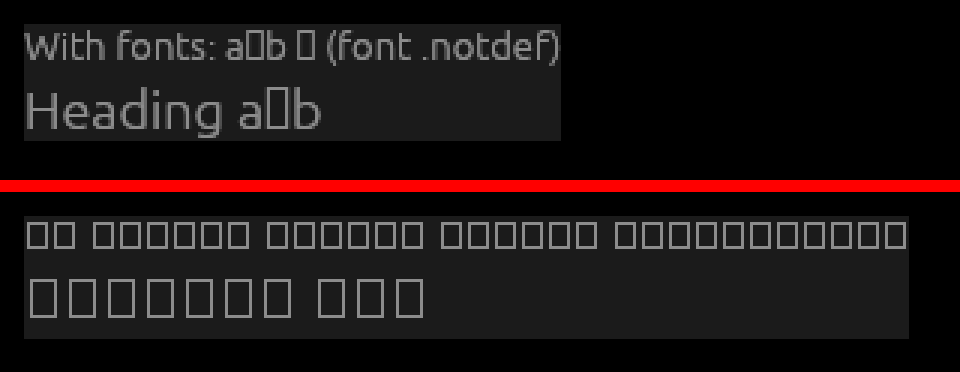
Top: with fonts, U+10FFFD drawn with Ubuntu's `.notdef`. Bottom: the
same UI with `FontDefinitions::empty()`, all synthetic tofu (3× zoom):

<picture>
<img
src="https://static.rerun.io/tofu_cmp/1c2a567a1f53c301897e716452974a0b6fbc8e12/full.png"
alt="">
<source media="(max-width: 480px)"
srcset="https://static.rerun.io/tofu_cmp/1c2a567a1f53c301897e716452974a0b6fbc8e12/480w.png">
<source media="(max-width: 768px)"
srcset="https://static.rerun.io/tofu_cmp/1c2a567a1f53c301897e716452974a0b6fbc8e12/768w.png">
</picture>

Written by Claude (LLM) together with @emilk.

* [x] I have followed the instructions in the PR template

🤖 Generated with [Claude Code](https://claude.com/claude-code)

---------

Co-authored-by: Claude Fable 5.1 <noreply@anthropic.com>
`Context::add_glyph_rasterizer` appended a rasterizer and requested a
repaint on every call. Calling it from a setup path that runs each frame
piled up duplicates and kept the UI repainting forever (we hit this in
rerun's tests, where `apply_style_and_install_loaders` runs every frame
and the harness never settled).

* `GlyphRasterizer::new` now takes a mandatory `key`: adding a
rasterizer whose key is already installed is a no-op.
* `Context`/`Fonts`/`FontsImpl::add_glyph_rasterizer` only reload fonts,
clear caches and request a repaint when something actually changed.
`Fonts::add_glyph_rasterizer` returns whether it did.
* `SvgGlyph::into_rasterizer` is keyed by cluster, the web canvas
rasterizer by a fixed name.

Written by an LLM (Claude) together with @emilk.

* [x] I have followed the instructions in the PR template

🤖 Generated with [Claude Code](https://claude.com/claude-code)

---------

Co-authored-by: Claude Fable 5.1 <noreply@anthropic.com>
Remove `default_fonts` from the list of default features of `egui` and
`epaint`, but keep it for `eframe`.

This is so that 3rd party egui crates don't accidentally force the
`default_fonts` feature on all upstream users.

Co-authored-by: Claude Opus 5 <noreply@anthropic.com>
`GlyphRasterizer` now has a `FontPriority`:

* `FontPriority::Highest`: asked about every cluster, before any font.
Use it to override how specific glyphs looks
* `FontPriority::Lowest` (default): a fallback, only asked about
clusters no installed font (or `FontProvider`) has. Same as before.

Several rasterizers can be installed; within a tier they are asked in
order, and the first `Some` wins.

```rust
ctx.add_glyph_rasterizer(
    egui::GlyphRasterizer::new(|request| (request.cluster == "…").then(|| my_ellipsis(request)))
        .with_priority(egui::FontPriority::Highest),
);
```

API changes (all unreleased): `Context::set_glyph_rasterizer(Option)` →
`add_glyph_rasterizer` / `set_glyph_rasterizers(Vec)`, same on
`epaint::Fonts`.

Follow-up to:
* https://github.com/emilk/egui/pull/8512

* [x] I have followed the instructions in the PR template

🤖 Generated with [Claude Code](https://claude.com/claude-code)

---------

Co-authored-by: Claude Fable 5.1 <noreply@anthropic.com>
Eguis built in widgets should work right even if there are no
default/system fonts. This renders the submenubutton triangle with
epaint so it will always look right and isn't system-font dependent.

---------

Co-authored-by: Claude Opus 5 (1M context) <noreply@anthropic.com>
`Font<'a>` was a hand-rolled split borrow of every field of `FontsImpl`,
and it grew a new `&'a mut` for each new feature. `text_layout` now
calls `FontsImpl` directly (`resolve_face`, `glyph_info`,
`allocate_glyph`, `rasterize_cluster`, …) with a cheap `FamilyKey` index
instead of re-hashing the `FontFamily` per glyph.

`font.rs` is renamed to `font_face.rs`, since only `FontFace` is left in
it. `FontsView::characters` replaces `f.fonts.font(family).characters()`
in the font book demo.

`FontsImpl` and `epaint::text::layout` are now crate-private: nothing
outside `epaint` used them, and `Fonts` / `FontsView` cover the public
API. The `fonts` fields of `Fonts` and `FontsView` are private too. The
benchmark that used `layout` directly now calls the new
`Fonts::layout_uncached`.

* [x] I have followed the instructions in the PR template

PR chain, in order:
* #8490
* #8500
* #8501
* #8502
* #8503
* #8504
* #8491
* #8492
* #8493

---------

Co-authored-by: Claude Fable 5.1 <noreply@anthropic.com>
`Family::resolve` is now the only place that decides which face renders
a char: it walks the chain, consults the per-char cache, and falls back
to the replacement face. `Font` no longer reaches into the family's
fields. Asking font providers (#8491) for a missing char becomes one
more branch in `Family::resolve`.

* [x] I have followed the instructions in the PR template

PR chain, in order:
* #8490
* #8500
* #8501
* #8502
* #8503
* #8504
* #8491
* #8492
* #8493

---------

Co-authored-by: Claude Fable 5.1 <noreply@anthropic.com>
`FaceStore` wraps the old `fonts_by_id` and `fonts_by_name` maps and
owns `FontFaceKey`. It has a single `install(name, &FontData)` so fonts
from `FontDefinitions` and fonts found later by a font provider (#8491)
go through the same code.

* [x] I have followed the instructions in the PR template

PR chain, in order:
* #8490
* #8500
* #8501
* #8502
* #8503
* #8504
* #8491
* #8492
* #8493

---------

Co-authored-by: Claude Fable 5.1 <noreply@anthropic.com>
`GlyphAtlas` owns the `TextureAtlas` plus every cache that points into
it (outline glyphs keyed by face, and platform-rasterized glyphs).
`FontFace` no longer knows about the atlas: it just renders an outline
to a bitmap.

When the atlas gets full, `Fonts::begin_pass` now clears the bitmaps
instead of reparsing and re-hinting every font face. That also removes
the duplicated `glyph_rasterizer` field on `Fonts`, which only existed
to survive the rebuild. Fonts found by font providers (#8491) will
survive an atlas clear the same way.

* [x] I have followed the instructions in the PR template

PR chain, in order:
* #8490
* #8500
* #8501
* #8502
* #8503
* #8504
* #8491
* #8492
* #8493

---------

Co-authored-by: Claude Fable 5.1 <noreply@anthropic.com>
Pure move, no logic changes. First step of a chain that untangles
`Font`, `FontsImpl`, and `CachedFamily` ahead of font providers (#8491).

New files under `crates/epaint/src/text/`: `font_id.rs`, `font_data.rs`,
`font_tweak.rs`, `font_definitions.rs`, `glyph_rasterizer.rs`,
`galley_cache.rs`, `styled_metrics.rs`, `unicode.rs`.

* [x] I have followed the instructions in the PR template

PR chain, in order:
* #8490
* #8500
* #8501
* #8502
* #8503
* #8504
* #8491
* #8492
* #8493

---------

Co-authored-by: Claude Fable 5.1 <noreply@anthropic.com>
Instead of opting in to pedantic lints one by one, enable the whole
group and opt out of the noisy ones.

64% of the pedantic lints were already listed individually. This deletes
90 explicit lint lines, enables 51 pedantic lints we never listed, and
picks up new pedantic lints for free. Each opt-out carries its hit
count, so the cost of turning one back on is visible.

`restriction` and `nursery` stay opt-in per lint.

Stacked on top of #8430, which fixes the one real bug the new lints
found.

* [x] I have followed the instructions in the PR template

---------

Co-authored-by: Claude Opus 5 (1M context) <noreply@anthropic.com>
## Summary

- Add `LayoutJob::clear` to reuse layout settings while rebuilding text.
- Cover preservation of every layout setting.

## Test

- `cargo clippy -p epaint --all-features --all-targets`
- `cargo test -p epaint --all-features`

* [x] I have followed the instructions in the PR template
We had a ton of issues around `TexturesDelta` that weren't properly
applied because we early-out of some function:
* https://github.com/emilk/egui/pull/8313
* https://github.com/emilk/egui/pull/8250
* https://github.com/emilk/egui/pull/8279

This PR changes texture updates, so that we always store them after
taking them out of `FullOutput` and keep the delta around until it's
actually applied (by passing &mut refs and draining instead of
iterating). So even if we add a new early return somewhere, that can't
break texture updates.

It also optimizes `TexturesDelta::append` by dropping any previous
deltas if there's a new `whole` delta or a `free`.

It also adds a debug assert that any `TexturesDelta` is empty when
dropped, as an additional safeguard in case the bug sneaks back in.

---------

Co-authored-by: Claude Opus 5 (1M context) <noreply@anthropic.com>
## Summary

- [x] I have followed the instructions in the PR template

Fixes comment-style violations of the `CONTRIBUTING.md` code style rule:

> `// Comment like this.` and not `//like this`

### Files changed

- `crates/epaint/src/shapes/bezier_shape.rs`: `//temporary solution` →
`// temporary solution`, and 22× `//add the start point` → `// add the
start point`
- `crates/egui/src/animation_manager.rs`: `//start new animation…` → `//
start new animation…`
- `crates/eframe/src/web/web_painter_wgpu.rs`:
`//create_new.instance_descriptor…` → `//
create_new.instance_descriptor…`

No code logic changes — only adding the missing space after `//` in
inline and standalone comments.

## Test plan

- [x] `cargo fmt --check`
- [x] `cargo clippy -p epaint -p egui`
- [x] `cargo test -p epaint --lib`
Fixes#8079, where font hinting only sharpens the vertical axis
(vertical stems stay blurry), and none of the skrifa knobs were
reachable — only switching to `Target::Mono` helped, but that wasn't
exposed.
This makes the hinting target configurable instead of hardcoding
`Target::Smooth { symmetric_rendering: true, preserve_linear_metrics:
true }`.
### API
- New `epaint::text::HintingTarget` mirroring `skrifa::outline::Target`:
- `Mono`
- `Smooth(SmoothHinting)` where `SmoothHinting { light,
symmetric_rendering, preserve_linear_metrics }`
- New field `FontTweak::hinting_target: HintingTarget`.
- Each variant/field is documented with what it does and the
egui-specific caveats (e.g. `symmetric_rendering` only affects
interpreter-hinted fonts; egui positions glyphs from shaper advances so
`preserve_linear_metrics` mostly affects sharpness, not layout).
### Render
- `font.rs` converts `HintingTarget` → `skrifa::outline::Target` and
threads it into the per-glyph `reconfigure` call; the hinting instance
is also reconfigured when the target changes.
### UI
- The font-tweak settings panel gets a `hinting_target` row: Smooth/Mono
radios, `light` / `symmetric_rendering` / `preserve_linear_metrics`
checkboxes, and a `Reset` button — all with tooltips.
### Behavior
- `HintingTarget::default()` matches egui's previous hardcoded target,
so **rendering is unchanged** unless you opt in. To fix the horizontal
blur from #8079, uncheck `preserve_linear_metrics` (or pick `Mono`).
Whether to flip the *default* is left as a follow-up.
🤖 Generated with [Claude Code](https://claude.com/claude-code)
---------
Co-authored-by: Claude Opus 4.8 (1M context) <noreply@anthropic.com>
The `FontTweak` settings UI previously let you edit variable-font
variation coordinates only via free-form tag + value entry — you had to
*know* that e.g. `wght` exists and what range is valid.

This PR queries the font's actual variation axes and pre-populates the
UI.

### Changes
- **`epaint`**: new `FontData::variation_axes() ->
Vec<FontVariationAxis>` (skrifa-backed). Each `FontVariationAxis`
exposes the axis `tag`, human-readable `name`, `min`/`default`/`max`,
and `hidden`. Empty for static (non-variable) fonts.
- **`egui`**: extracted the `FontTweak` body into a public
`style::font_tweak_ui(ui, tweak, axes)`. When `axes` is non-empty, each
axis is shown as a named **slider** pre-filled with the font's default
and clamped to its valid range, with a ⟲ button to drop the override.
`impl Widget for &mut FontTweak` still exists and delegates with no axes
(free-form fallback, also used for unknown/manual tags).
- The font settings panel (`Context::fonts_tweak_ui`) now passes
`data.variation_axes()`.
- UI label renamed `coords` → **Axes** (matching Google Fonts'
terminology); the underlying `FontTweak.coords` field keeps the OpenType
"design coordinates" name.

🤖 Generated with [Claude Code](https://claude.com/claude-code)


Example (Weight and Width):
<img width="340" height="239" alt="Screenshot 2026-06-24 at 11 51 33"
src="https://github.com/user-attachments/assets/f898289a-e329-453a-ba86-c60858901466"
/>

Co-authored-by: Claude Opus 4.8 (1M context) <noreply@anthropic.com>
Less risk of confusing the two.

Found and fix a couple real bugs in the process!

---------

Co-authored-by: Claude Opus 4.8 (1M context) <noreply@anthropic.com>
This PR adds two small additions to `LayoutJob`:

- `LayoutJob::format_at_byte` to query the `TextFormat` of the section
covering a given byte index.
- An optimization to `LayoutJob::append` that merges newly appended text
into the previous section when the format matches and there is no
leading space.

It also documents the `LayoutJob::sections` invariant (sections are
ordered and together cover the whole text with no gaps or overlaps) and
adds `LayoutJob::debug_sanity_check`, which verifies this in debug
builds. It is called from `format_at_byte` and from the text layouter.

## Why the `easymarkeditor` snapshot changed

The `append` optimization changes how many sections a `LayoutJob` ends
up with: consecutive runs of identically-formatted text now collapse
into a single section instead of one section per `append` call. The
easymark editor produces many such adjacent same-format sections, so it
is affected.

This matters because text is **shaped per section**: `layout_section`
runs the shaper once per section, so each section is an independent
shaping run. Merging two adjacent sections into one means the text
across the old boundary is now shaped together as a single run, which
enables cross-boundary kerning (and, in principle, ligatures) that
previously did not happen. Additionally, `extra_letter_spacing` is
skipped before the first glyph of a section, so merging removes a "first
glyph" boundary and lets the spacing apply there.

The net effect is sub-pixel glyph position shifts at the former section
boundaries, which is why `easymarkeditor.png` was regenerated. The new
output is the more correct one — the text is now shaped as the author
wrote it, rather than being artificially split at `append` boundaries.

---------

Co-authored-by: Copilot Autofix powered by AI <175728472+Copilot@users.noreply.github.com>
Co-authored-by: Claude Opus 4.8 (1M context) <noreply@anthropic.com>